INFO MAHASISWA BARU

Syarat Pendaftaran

Calon mahasiswa STIBA-IEC Jakarta adalah lulusan SMA/SMK/MA dari semua jurusan
Mengisi dan menyerahkan formulir pendaftaran dengan melampirkan:
  •  Satu (1) lembar fotocopy ijazah dan daftar NEM SMU/SMK  yang telah dilegalisasi.
  • Satu (1) lembar Fotocopy KTP dan KK.
  • Empat (4) lembar Pas foto berwarna  ukuran 3×4 cm.
  • Mengikuti tes penerimaan Mahasiswa Baru


Waktu Pendaftaran

Waktu PendaftaranTes Masuk
Gel.INop. 2019 – April 202025 April 2020
Gel.IIMei 2019 – Juni 202020 Juni 2020
Gel.IIIJuli 2019 – Agustus 202022 Agustus 2020

Tes Masuk meliputi:

  1. Tes Potensi akademik (Numerik,Verbal,Analisis).
  2. Bahasa Inggris
Tes dilaksanakan pada hari sabtu

Pendaftaran dibuka

  • Senin s.d Jum’at : 08:00 – 20:00 WIB
  • Sabtu                        : 08:00 – 17:00 WIB

Segera hubungi:

Telp.021-8518685

SMS/WA: 0856-9540-0674 (Ms. Teeny)

VISI, MISI dan TUJUAN

VISI, MISI & TUJUAN

VISI, MISI DAN TUJUAN
STIBA-IEC JAKARTA

VISI
“Menjadi sekolah tinggi yang berkualitas dan unggul di bidang bahasa dan sastra asing pada tahun 2030 di wilayah DKI Jakarta yang berstandar nasional dan mampu berperan aktif dalam pembangunan bangsa melalui proses pendidikan, penelitian dan pengabdian masyarakat.”

MISI
  1. Menyelenggarakan kegiatan pendidikan dan pengajaran bahasa dan sastra asing (Bahasa dan Sastra Inggris) yang berkualitas.
  2. Melaksanakan kegiatan penelitian untuk pengembangan ilmu pengetahuan dan teknologi secara berkelanjutan.
  3. Menerapkan temuan-temuan penelitian yang bermanfaat bagi masyarakat dalam bentuk pengabdian kepada masyarakat.
  4. Melakukan sosialisasi tentang eksistensi dan program-program sekolah tinggi kepada masyarakat secara terencana dan terus menerus melalui kegiatan dan relasi publik.
  5. Memberikan pelayanan kepada masyarakat di bidang bahasa dan sastra asing (Bahasa dan Sastra Inggris) dan pengajarannya

TUJUAN
  1. Menghasilkan lulusan tingkat sarjana bahasa dan sastra asing (Bahasa dan Sastra Inggris) yang bermoral dan berkompeten dalam bidangnya dan memiliki daya analisis, berfikir sistematis dan logis, berwawasan luas, berdedikasi terhadap ilmu pengetahuan dan teknologi, memiliki integritas kepribadian, serta menjunjung tinggi nilai-nilai kemanusiaan.
  2. Mengembangkan ilmu pengetahuan di bidang bahasa dan sastra asing (Bahasa dan Sastra Inggris) melalui kegiatan penelitian.
  3. Mengimplementasikan keahlian dan pengetahuan di bidang bahasa dan sastra asing (Bahasa dan Sastra Inggris) kepada masyarakat.
  4. Menjalin kemitraan dalam upaya pemberdayaan dan peningkatan sumber daya manusia.
  5. Menyiapkan lulusan yang dapat menerapkan keahliannya dalam bidang bahasa dan sastra asing (Bahasa dan Sastra Inggris) serta dapat memenuhi kebutuhan masyarakat

BEASISWA

BEASISWA STIBA-IEC JAKARTA
TAHUN AKADEMIK 2019/2020

 Beasiswa Awal KuliahPersyaratan
Potongan/Diskon Rp. 2.000.000 untuk biaya Semester 1Hasil test masuk STIBA-IEC Jakarta min. 90
Potongan/Diskon Rp. 1.000.000 untuk biaya semester 1Hasil test masuk STIBA-IEC Jakarta min. 80
Beasiswa Khusus
Bantuan biaya kuliah1.Mahasiswa berprestasi
2.Mahasiswa kurang mampu
STIBA-IEC juga memberikan Beasiswa bagi mahasiswa yang mempunyai prestasi akademik yang menonjol dan yang kurang mampu dengan maksud meningkatkan gairah belajar dan meningkatkan prestasi mahasiswa. Beasiswa tersebut diharapkan berasal dari:
  •     Beasiswa Supersemar
  •     Beasiswa Yayasan
  •     Beasiswa Departemen Pendidikan Nasional
  •     Beasiswa dari instansi lain


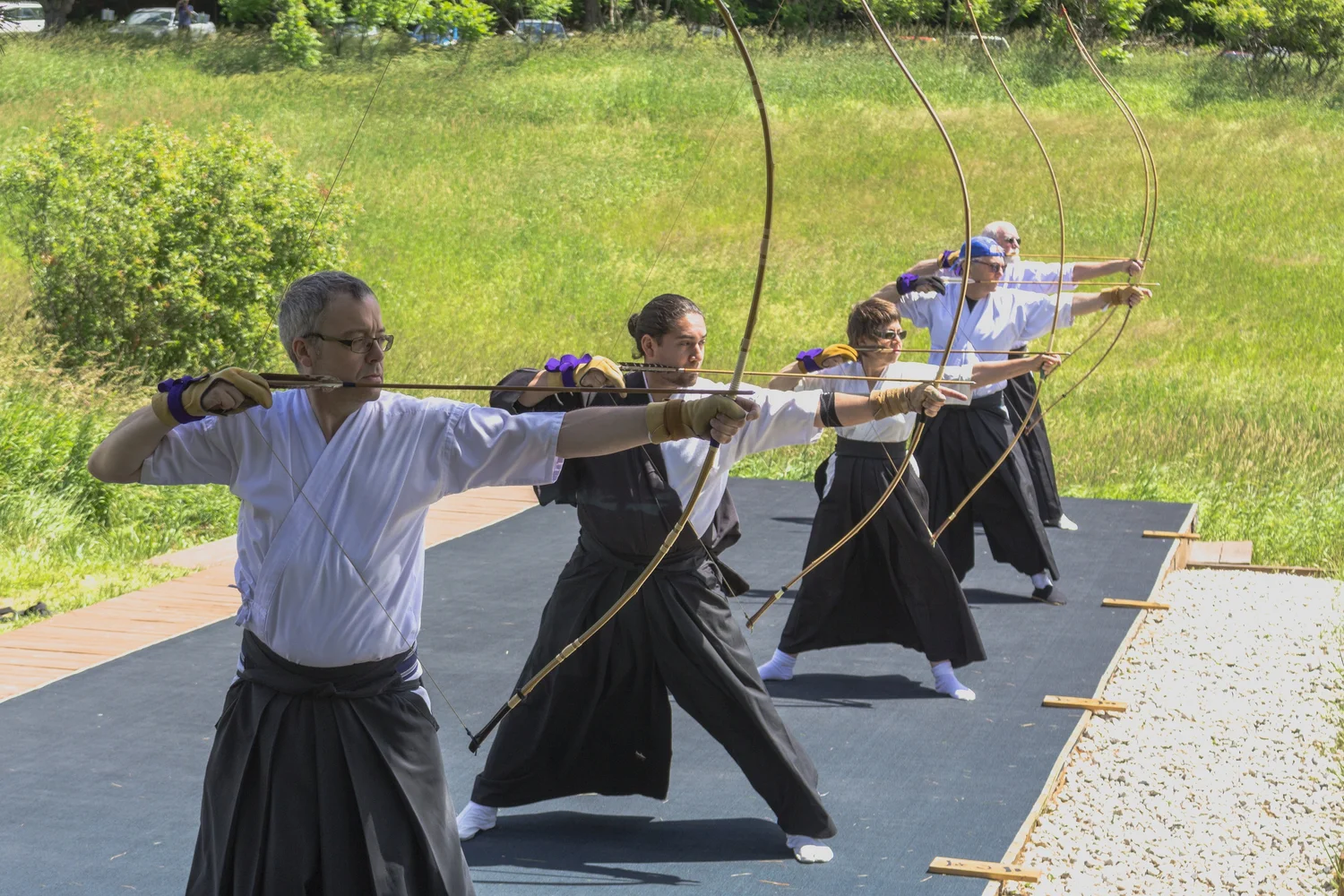
Kyūdō

Kyūdō


 Kyūdō (弓道) is the Japanese martial art of archery. Experts in kyūdō are referred to as kyūdōka (弓道家). Kyūdō is based on kyūjutsu ("art of archery"), which originated with the samurai class of feudal Japan. Kyūdō is practised by thousands of people worldwide. As of 2005, the International Kyudo Federation had 132,760 graded members

The beginning of archery in Japan is pre-historical. The first images picturing the distinct Japanese asymmetrical longbow are from the Yayoi period (c. 500 BC – 300 AD). 

Click Here to see more about Kyudo 


Sepak takraw

Sepak takraw


Sepak takraw,or kick volleyball, is a sport native to Southeast Asia. Sepak takraw differs from the similar sport of footvolley in its use of a rattan ball and only allowing players to use their feet, knee, chest and head to touch the ball.
In Malaysia, Indonesia and Singapore, it is called sepak takraw. In Malaysia, it can be known as sepak raga as well. In the Philippines, the related native sport is known as sipà, while the international version is known by the borrowed terms sipà tákraw or sepak takraw. In Thailand, it is known simply as takraw. In Laos, it is kataw (Lao: "twine" and "kick"). In Myanmar, it is known as chin lone, and is considered more of an art as there is often no opposing team, and the point is to keep the ball aloft gracefully and interestingly.


Cricket

Cricket


Cricket is a bat-and-ball game played between two teams of eleven players on a field at the centre of which is a 20-metre (22-yard) pitch with a wicket at each end, each comprising two bails balanced on three stumps. The batting side scores runs by striking the ball bowled at the wicket with the bat, while the bowling and fielding side tries to prevent this and dismiss each player (so they are "out"). Means of dismissal include being bowled, when the ball hits the stumps and dislodges the bails, and by the fielding side catching the ball after it is hit by the bat, but before it hits the ground. When ten players have been dismissed, the innings ends and the teams swap roles. The game is adjudicated by two umpires, aided by a third umpire and match referee in international matches. They communicate with two off-field scorers who record the match's statistical information. 


Freelance


Freelance (sometimes spelled free-lance or free lance), freelancer, and freelance worker, are terms commonly used for a person who is self-employed and is not necessarily committed to a particular employer long-term. Freelance workers are sometimes represented by a company or a temporary agency that resells freelance labor to clients; others work independently or use professional associations or websites to get work.
While the term independent contractor would be used in a different register of English to designate the tax and employment classes of this type of worker, the term "freelancing" is most common in culture and creative industries, and use of this term may indicate participation therein.
Fields, professions, and industries where freelancing is predominant include: music, writing, acting, computer programming, web design, graphic design, translating and illustrating, film and video production and other forms of piece work which some cultural theorists consider as central to the cognitive-cultural economy.

Moving company


A moving company, removalist or van line is a company that helps people and businesses move their goods from one place to another. It offers all-inclusive services for relocations like packing, loading, moving, unloading, unpacking, arranging of items to be shifted. Additional services may include cleaning services for houses, offices or warehousing facilities.

Video game publisher


A video game publisher is a company that publishes video games that have been developed either internally by the publisher or externally by a video game developer.
They often finance the development, sometimes by paying a video game developer (the publisher calls this external development) and sometimes by paying an internal staff of developers called a studio. The large video game publishers also distribute the games they publish, while some smaller publishers instead hire distribution companies (or larger video game publishers) to distribute the games they publish. Other functions usually performed by the publisher include deciding on and paying for any licenses used by the game; paying for localization; layout, printing, and possibly the writing of the user manual; and the creation of graphic design elements such as the box design. Some large publishers with vertical structure also own publishing subsidiaries (labels).
Large publishers may also attempt to boost efficiency across all internal and external development teams by providing services such as sound design and code packages for commonly needed functionality.
Because the publisher often finances development, it usually tries to manage development risk with a staff of producers or project managers to monitor the progress of the developer, critique ongoing development, and assist as necessary. Most video games created by an external video game developer are paid for with periodic advances on royalties. These advances are paid when the developer reaches certain stages of development, called milestones.

Minecraft


Minecraft is a sandbox video game created by Swedish developer Markus Persson, released by Mojang in 2011 and purchased byMicrosoft in 2014. It is the single best-selling video game of all time, selling over 180 million copies across all platforms by late 2019, with over 112 million monthly active players.
In Minecraft, players explore an intentionally blocky, pixelated, procedurally-generated 3D world, and may discover and extract raw materials, craft tools, build structures or earthworks, and, depending on game mode, can fight computer-controlled foes, as well as either cooperate with or compete against other players in the same world. These modes include a survival mode, in which players must acquire resources to build the world and maintain health, and a creative mode, where players have unlimited resources. In theJava Edition, players can modify the game with mods to create new gameplay mechanics, items, textures and assets.
Minecraft has been critically acclaimed, winning numerous awards, and has been described as one of the most influential and greatest video games of all time. Social media, parodies, adaptations, merchandise, and the annual MineCon conventions played large roles in popularizing the game. It has also been used in educational environments, especially in the realm of computing systems, as virtual computers and hardware devices have been built in it. A number of spin-off games have also been developed, such as Minecraft: Story Mode, Minecraft Earth, and Minecraft Dungeons.

Counter Strike : Global Offensive


Counter-Strike: Global Offensive is a multiplayer first-person shooter video game developed by Valve and Hidden Path Entertainment. It is the fourth game in the Counter-Strike series and was released for Windows, OS X, Xbox 360, and PlayStation 3 in August 2012, while the Linux version was released in 2014.
The game pits two teams against each other: the Terrorists and the Counter-Terrorists. Both sides are tasked with eliminating the other while also completing separate objectives. The Terrorists, depending on the game mode, must either plant the bomb or defend the hostages, while the Counter-Terrorists must either prevent the bomb from being planted, defuse the bomb, or rescue the hostages. There are nine game modes, all of which have distinct characteristics specific to that mode. The game also has matchmaking support that allows players to play on dedicated Valve servers, as well as allowing members of the community to host their own servers with custom maps and game modes. A battle-royale game-mode, "Danger Zone", was introduced in 2018.
Global Offensive received positive reviews from critics on release, who praised for its gameplay and faithfulness to predecessors, though it was criticized for some of its early features and was noted for differences between the console and PC versions. Since its release, it has drawn in an estimated 11 million players per month, and has gathered an active competitive scene, with many tournaments sponsored by Valve themselves. In December 2018, Valve transitioned the game to a free-to-play model, focusing on